
Implementation guide · 14 days
Launch employee recognition in Slack without creating another program to babysit
A recognition program works when the first action is obvious, the message has context, and the habit belongs in the flow of work. Use this two-week plan to run a focused pilot, learn from real examples, and expand only when the team is ready.
30-day free trial · No credit card required · Install in under 2 minutes
The launch principle
Start with a habit, not a feature tour
Employees do not need a new culture initiative to learn. They need one sentence that answers: who can I recognize, where do I do it, and what does a useful message look like? Make that action work in Slack before adding rewards, campaigns, or a company-wide leaderboard.
The one-sentence brief
“When you see a teammate make a difference, give a specific kudos in #team-recognition and name the value or outcome it shows.”
Put this in the channel topic, onboarding notes, and the first manager message.
The 14-day rollout
Days 0–1
Choose the pilot
Pick one team, one channel, one owner, and one behavior you want to make more visible.
Days 2–3
Configure the workflow
Install Karl, choose values, invite the bot to the pilot channel, and test one real kudos.
Days 4–7
Model the habit
Ask managers and champions to post specific examples tied to an outcome or value.
Days 8–10
Make it easy to copy
Share three examples, add the workflow to onboarding or stand-up notes, and invite peer recognition.
Days 11–14
Review and improve
Check participation, message quality, and who is missing; then adjust prompts before expanding.
Write recognition people can copy
The first examples set the quality bar. Keep them short, specific, and connected to a real outcome. These examples are templates—not customer quotes.
Customer impact
Kudos to @Sam for turning the customer feedback into a clear launch checklist. It made the handoff easier for everyone. · Customer focus
Behind-the-scenes work
Thanks @Priya for catching the billing edge case before release. That careful review protected the launch. · Ownership
Team support
Shoutout to @Alex for pairing with the new teammate and documenting the setup. The whole team can move faster now. · Teamwork
Admin feedback loop
Measure adoption without turning people into scores
During the pilot, track whether the workflow is becoming useful—not whether one person is “winning.” Karl’s dashboard and analytics can help you review participation and values alongside the messages that explain them.
Activation
Did the workspace send its first useful kudos?
Breadth
Are giving and receiving spreading across roles?
Quality
Do messages name a contribution and its impact?
A customer example should teach a pattern
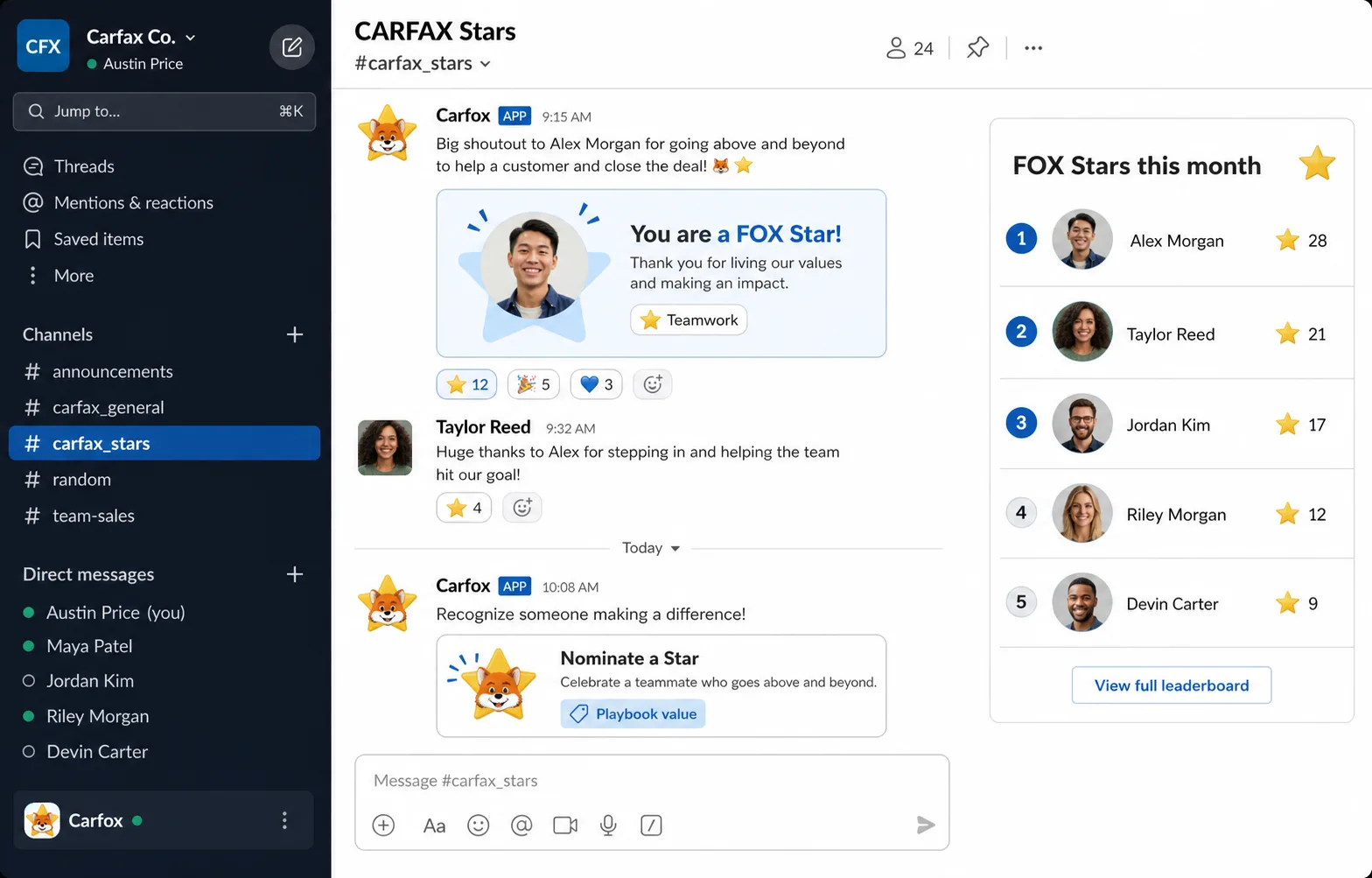
The CARFAX/Carfox example shows how a team can adapt the identity, language, values, channel, and leaderboard to its own program. That is useful implementation proof even without a performance claim. Keep outcome metrics, quotes, and logos behind an explicit customer-approval gate; do not fill the gap with invented case-study numbers.
Case-study checklist for the next approved customer
- • Problem and team context
- • Launch channel and rollout owner
- • Before/after participation with consent
- • One attributable quote, approved in writing
- • Screenshot with names anonymized where needed
- • A link to the customer story from the commercial page
Ready to run the pilot? See Slack employee recognition, review the kudos workflow, or start the 30-day trial.
Give teammates examples they can adapt
Start with the 24 Slack kudos examples for customer work, mentoring, launches, and company values. Share a few that fit your team, then replace the names and details with real contributions.
Frequently asked questions
How long does it take to launch recognition in Slack?+
A focused pilot can be ready in a day and learn enough to improve in two weeks. Start with one channel, a small set of value examples, a few manager champions, and one participation signal before expanding.
Which Slack channel should recognition use?+
Choose a shared channel where the team already celebrates work, or create a clearly named recognition channel. Keep the first pilot easy to discover, then add private or team-specific channels only when the workflow proves useful.
How do we avoid making recognition feel forced?+
Model specific appreciation, keep participation voluntary, celebrate different roles and contribution types, and use analytics as a prompt for coaching—not a score for performance or compensation.
Make recognition part of the workday.
Start with the Slack workflow your team already uses, then measure the habits that grow from it.