Buyer’s guide · pricing checked 12 Sep 2026
The best Slack employee recognition apps, compared honestly
Recognition tools look similar in a demo. The important differences are where recognition happens, what the signal means, how much admin work it creates, and whether rewards are actually part of your program. Use this comparison to choose the smallest workflow that can become a habit.
30-day free trial · No credit card required · Install in under 2 minutes
Start with the decision
Recognition, rewards, feedback, or all three?
A team that wants to thank a teammate for unblocking a launch has a different job from a People team running a points budget, pulse surveys, and anniversary automation. Write the first behavior you want to change before comparing feature lists.
- • Can a teammate complete the important action without leaving Slack?
- • Can admins choose channels, visibility, and permissions?
- • Are values and the original story attached to the signal?
- • Who owns rewards, reporting, and the next program experiment?
For a closer product-fit check, compare Karl's Slack employee recognition workflow, Slack kudos bot, and employee recognition leaderboard before choosing a broader platform. See Karl’s actual product screens with a labeled demonstration workspace.
A fair pilot
- 1. Pick one team. Use a real channel and a real recognition moment.
- 2. Define one success signal. For example, the share of teammates who give or receive a specific kudos.
- 3. Run it for two weeks. Measure setup effort, first-use time, participation, and message quality.
- 4. Ask the team. Keep what feels natural; remove anything that creates noise or pressure.
Slack recognition apps side by side
Karl publishes this guide and is one of the products compared. We selected five Slack-integrated tools covering focused recognition and broader rewards programs. Feature summaries use the linked vendor descriptions; this is desk research, not a hands-on test of every product. Fit recommendations are our editorial judgment. Pricing was separately checked on 12 September 2026.
| App | Best fit | Core workflow | Measurement | Rewards | Trade-off |
|---|---|---|---|---|---|
| KarlKarl product pages | Slack-first kudos and values | Kudos in Slack with optional value tags and GIFs | Leaderboards, analytics, and TV stream | Recognition-led; no rewards catalog required | Choose another tool if rewards redemption or surveys are the primary requirement. |
| MatterSlack Marketplace listing | Recognition, rewards, surveys, and celebrations | Kudos templates and feedback rituals inside Slack | Recognition, rewards, and feedback analytics | Matter coins, gift cards, company rewards, and donations | Broader suite means more configuration if you only need simple kudos. |
| HeyTacoHeyTaco Slack integration | A playful taco-based recognition habit | Teammates give tacos directly in Slack | Leaderboards, values, and engagement reporting | Optional rewards and milestones | The taco mechanic is a strong fit when your culture wants a visible token. |
| BonuslyBonusly Slack integration | Recognition with a broader rewards program | Slack recognition through the /give workflow | Recognition and rewards reporting | Points and rewards are central to the program | Evaluate platform breadth, budget, and admin ownership before a rollout. |
| NectarNectar Slack integration | Recognition plus milestones and rewards | Recognition, notifications, and milestones in Slack | Program reporting and participation views | Rewards and milestone workflows are available | A better fit when HRIS, milestones, and rewards matter alongside Slack. |
Sources: Matter on the Slack Marketplace, HeyTaco for Slack, Bonusly + Slack, and Nectar + Slack. Checked 1 Aug 2026.
What will recognition cost at your team size?
The planning examples below assume 25, 100, or 150 billable people. Amounts are USD per month or monthly equivalents as labeled, before tax, rewards spending, and negotiated discounts. Annual equivalents are charged annually, not monthly. Plans have different features; a lower subscription price does not mean an equivalent service.
| Plan and billing basis | 25 people | 100 people | 150 people |
|---|---|---|---|
| Karl Team · $1.49/person, monthly | $37.25 | $149.00 | $223.50 |
| Karl Team · $0.99/person monthly equivalent, annual | $24.75 | $99.00 | $148.50 |
| Matter Basic · $1/person monthly equivalent, annual | $25.00 | $100.00 | $150.00 |
| Matter Pro · $3/person monthly equivalent, annual | $75.00 | $300.00 | $450.00 |
| HeyTaco Classic · $3/person, monthly | $75.00 | $300.00 | $450.00 |
| HeyTaco Deluxe · $5/person, monthly | $125.00 | $500.00 | $750.00 |
Karl pricing: Team includes values, leaderboards, analytics, GIFs, and TV stream mode. For 100 employees, annual billing is $1,188 upfront; monthly billing is $149 per month. Checkout uses the billable employee count selected in the dashboard.
Matter pricing: Basic includes custom kudos and analytics; Pro adds rewards and challenges. Surveys are an additional $2 per user/month billed annually. A free plan is available. Budget reward spending separately from the subscription.
HeyTaco pricing: Classic includes custom rewards and leaderboards. Deluxe adds automated milestones, instant gift cards, and advanced analytics. Billing can follow participants who give or receive tacos or a selected team; confirm the seat basis before comparing it with your full headcount.
Bonusly pricing: the published FAQ lists Team with Bizy at $5/user monthly or $50/user annually, and a version without Bizy at $3 monthly or $30 annually. However, the same page also says all plans are billed annually. Confirm the available billing term and AI inclusion with Bonusly; we have left it out of the calculated table rather than treating conflicting terms as a quote. Rewards are additional.
Nectar pricing: request pricing for the relevant bundle. We found no public per-seat rate on its pricing page, so a comparable total requires a quote.
Price sources checked 12 September 2026. Arithmetic assumes the stated number of billable seats, with no volume adjustment. Verify the final plan, seat rules, rewards budget, taxes, and contract with each provider before purchasing.
Recognition without rewards or a points-based program?
Start with appreciation
Choose this when the main job is to make useful contributions visible. A specific message, a company value, and a monthly review may be enough. Karl fits this workflow; you do not need to establish a gift-card budget to start.
The program owner still needs to model good examples and notice who is missing. Low administration does not mean a habit appears automatically.
Add rewards when they serve a purpose
Choose a rewards-capable plan when redeemable points, gifts, or milestones are part of your program. Confirm the catalog works for your employees’ locations, how balances are funded, and who handles fulfillment.
Plan the subscription and reward budget separately. Keep the reason for the recognition visible so the reward does not replace the message of appreciation.
A practical shortlist for a 150-person remote team
For peer shoutouts tied to values, pilot Karl and Matter Basic. If a taco mechanic suits the team, include HeyTaco. If gift redemption is required from day one, evaluate the relevant rewards plans from Matter, HeyTaco, Bonusly, and Nectar. Treat this as a starting shortlist, then test the actual workflow with your team.
Before an admin approves the app
- Review the Slack permission screen and ask which message, member, and profile information is needed. Karl documents its current categories on the security and permissions page.
- Choose the pilot channel, confirm who can install apps, and send the first recognition using an actual teammate mention.
- Check what employees can see, who can change settings, how to remove access, and how to cancel before the trial ends.
- Use the same pilot task for each product: send a useful kudos, connect a value if needed, find it in reporting, and record the admin effort.
Inside Karl · demonstration workspace
Follow a kudos from the message to the monthly count
Use the same small task when evaluating each app: recognize a helpful contribution, connect it to a value, then find the record and understand what gets counted.
These are captures of Karl’s dashboard, rendered with labeled demonstration data. Alex, Sam, the values, and the activity are fictional. The screens show the product workflow, not customer results. Select a screen to view it at full size.
1. Send a specific kudos and find its record
In your recognition channel, type /kudos, choose a teammate from Slack’s mention picker, and explain what they did. Review Karl’s confirmation and select a relevant value; your workspace may require one. Choose an optional GIF or None, then submit.
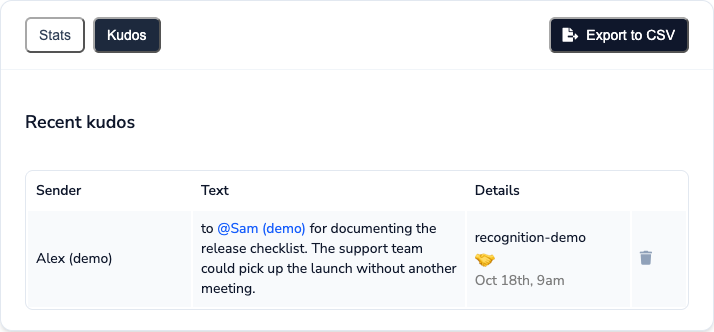
“Kudos to Sam for documenting the release checklist. The support team could pick up the launch without another meeting.”
Then open the dashboard’s Kudos tab. This example contains one kudos from Alex to Sam, with the message, channel, value emoji, and date visible together.
Use a real teammate mention instead of the sample name. The first-kudos walkthrough includes setup and troubleshooting.
2. Make the value behind the contribution clear
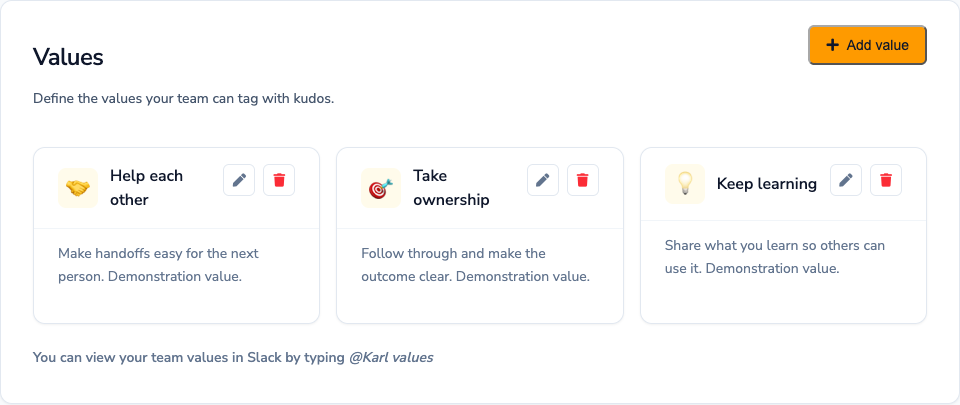
Open Values in the dashboard to add or edit your workspace’s values. Give each one a distinct emoji, a title, and a description teammates can act on.
Here, Help each other means making handoffs easier. It fits Sam’s checklist example. Those configured values are available in Karl’s Slack confirmation, so a value tag can point to a specific behavior.
Start with your own values. Our company-values setup guide explains the workflow and how to write useful examples.
3. Check the period and what the number means
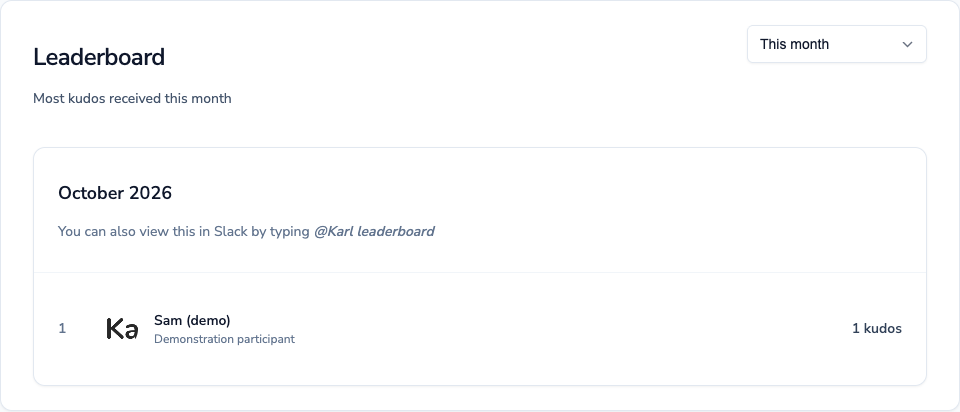
Open Leaderboard and choose This month. The dashboard shows workspace-wide kudos received for the displayed calendar month. In this example, Sam received the single recorded kudos, so Sam’s count is one.
The number measures recognition received. It does not measure performance, hours worked, or business impact. Read the underlying message and notice whose contributions have not been recognized before deciding what to change.
You can also request @Karl leaderboard in Slack. The leaderboard setup guide explains the Slack channel setting and counting rules.
Before your pilot, review Karl’s Slack permissions and check the price for your team. If your program needs its own recognition language, explore the custom-program example.
Where Karl is the right fit—and where it is not
Karl is a good fit when…
- • Slack is already where your team shares work.
- • You want recognition to stay timely and specific.
- • Values, analytics, leaderboards, or a TV stream matter.
- • You want to pilot without a credit card for 30 days.
Compare further when…
- • Rewards redemption is the core employee benefit.
- • You need surveys, HRIS sync, or milestone automation first.
- • Procurement requires a specific compliance or support package.
- • A broader employee-experience suite will replace several tools.
If you are ready to design the rollout, follow the 14-day Slack recognition implementation guide, or review Karl pricing.
Frequently asked questions
What is the best employee recognition app for Slack?+
The best app depends on the program you want to run. Karl is a strong fit for teams that want lightweight, Slack-first kudos with values, leaderboards, analytics, and a 30-day trial. Teams that need rewards redemption, surveys, or a broad HR platform may prefer a more expansive product.
Should we choose recognition software with rewards?+
Only if rewards are part of the behavior you want to reinforce and you have an owner for budgets and fulfillment. Start by deciding whether your first goal is timely appreciation, rewards, feedback, or all three; otherwise a larger platform can add cost and rollout friction without improving adoption.
How should we compare Slack recognition apps?+
Run a small pilot and compare the time to first recognition, participation across roles, message quality, admin effort, reporting, permissions, and total cost. Keep the original recognition story attached to every metric so volume does not become a proxy for performance.
Make recognition part of the workday.
Start with the Slack workflow your team already uses, then measure the habits that grow from it.